APRIL 1999 9 .
Carr's CAR reserve system by Dailan
Pugh
The Carr Government has now reserved 576,000 hectares in
north-east NSW since being elected: this represents an increase
of 6% of the area of the north-east now reserved. This is a major
and urgently needed expansion of the reserve system. So why is it
that despite this significant and historical increase in reserves
the outcome is considered grossly inadequate?
Prior to the last NSW State election, Carr achieved the
support of conservation groups (in part) because of promises to
protect old growth forest and wilderness and to undertake
comprehensive regional assessments (CRAs) to establish a
comprehensive, adequate and representative (CAR) reserve system.
The process was to be scientific; comply with the 1992 National
Forest Policy Statement; fulfill the national forestreserve
criteria; and involve conservation (as well as industry) groups.
The Commonwealth Government released the first proposed
national reserve criteria for forests in 1995.
Finally in 1997 the Howard and Carr governments, along with
other States, agreed to a significantly watered-down version of
those proposed. The criteria were meant to establish a baseline
to ensure that all States met minimum national requirements.
For the north-east NSW CRAs, data on environmental entities
(including 240 forest ecosystems, populations of 152 animal and
444 plant threatened species, old growth forest, wilderness and
core areas for endemic species) were collected. Targets were
established for each of these in accordance with the national
reserve criteria. Data on cultural and nationalestate values were
also collected, but were ignored by the State agencies.
The State agencies initially applied the data and reserve
targets to identify over one million hectares of public lands in
north-east NSW as required for addition to existing reserves.
Without the artificial constraints applied by the agencies,
conservationists identified 1.2 million ha as required to
reasonably establish a CAR reserve system for public lands.
On 12 November 1998 Premier Carr announced for north-east NSW
the creation of 358,200 ha of new national parks and nature
reserves; 20,100 ha of new Crown reserves (still available for
mining); and 3,800 ha of new State Forests' Flora Reserves. This
total area of 382,100 ha is comprised of 141,200 ha in the Upper
North East (UNE) and 240,900 ha in the Lower North East (LNE).
This brings the total area reserved in north-east NSW in the
CRA process (including the 1996 decision) to 544,000 ha. An
additional 32,000 was reserved in 1995. The total area covered in
north-east NSW is 9.7 million ha, so the area reserved since Carr
was elected represents 6% of the land area. The Government is now
also considering establishing reserves over some 30,000 ha of
vacant Crown lands (which is less than half of what the State
agencies agreed to).
Carr's reserve additions increase the area reserved to 13.6%
of the UNE and 20.4% of the LNE. It is important to recognise
that the LNE includes the distinctly separate Sydney Basin
biogeographical region south of the Hunter River, which already
has large reserves encompassing sandstone areas. When just the
area of LNE north of the Hunter River is considered, the new
reserves increase the reservation to only 14.9% of the area.
The primary scientific means of assessing the outcome is to
compare it to the environmental targets established to fulfil the
baseline national reserve criteria (see Table). This shows that
of all targets, only an average of 28% was achieved, while 21%
achieved less than 10% of that required. Threatened plant and
animal species were those with the poorest outcome. It is of
particular concern that those species and ecosystems identified
by the expert committees (including State Forests) as most
vulnerable to logging did worse than the average across all
entities.
Features No of %full target targets achievement 0-9.9
10-49.950-99.9 100+ Forest ecosystems 360 14% 23% 23% 39% Old
growth 315 10% 26% 37% 27% Fauna 788 23% 34% 15% 28% Flora 543
29% 30% 19% 22% Centres of 45 11% 40% 47% 2% endemism All
entities 2052 21% 30% 22% 28% Most vulnerable 1276 25% 35% 23%
17% entities After the new reservations there are still some
748,100 ha of forest ecosystems and 397,400 ha of old growth
requiring reservation to achieve the national reserve criteria.
Respectively, these target shortfalls are 3 and 4 times the total
of all such shortfalls in the Carr's CAR reserve system Dailan
Pugh* 10 APRIL 1999 Victorian, Tasmanian and Western Australian
CRAs added together!
Almost half the forest ecosystems still requiring reservation
in north-east NSW occur on public lands where they could have
been reserved. Only one-third of old growth forest identified on
public land outside existing reserves (as at 1998) was added to
reserves, leaving 240,300 ha unreserved. Of this, 170,900 ha
(71%) is still required to achieve the baseline national reserve
criteria.
Old growth forests which have been protected since 1990 by
Premier Greiner and since 1995 by Premier Carr will now be opened
up for logging. Some form of off-reserve management is proposed
for some proportion of this old growth, though as the
timbersupply crisis deepens any such discretionary protection
will prove to be very tenuous.
The total area of NPWS-identified wilderness in the north-east
is 1,002,500 ha, of which 795,100 ha (79%) is protected in
reserves. Of the 208,000 ha of wilderness to remain unprotected,
some 65,300 ha occurs on available public lands excluded from
reserves. In the UNE only 66% of `high quality wilderness' (NWI
12) is reserved, despite the national target of 90% or more if
practicable (there was no assessment for LNE).
While the best scientific data ever assembled for north-east
NSW's forests was available, in the end Carr's reserve system was
a political decision aimed at appeasing mining, grazing and
logging interests.
Carr's reserve system clearly fails to deliver on the science,
his pre-election promises, his own forest policy, the national
reserve criteria and the National Forest Policy. It is most
worrying that Carr apparently ignored these when he made his
decision.
The scientific data was not totally irrelevant as it did
ensure that some significant areas of the very poorly reserved
coastal and tableland forests were included in the outcome. It
now also provides a basis for justifying the need for a greatly
expanded reserve system and for identifying some of the most
important areas for inclusion.
While progress has been made, north-east NSW still does not
have a comprehensive, adequate and representative reserve system.
There will need to be a prolonged battle to achieve even the
minimalist national reserve criteria.
R.I.P. ESFM The most significant loss as a result of Carr's
decision is the public forests which will remain outside the
reserve system. The available timber is to be grossly
over-allocated in 20-year wood-supply agreements.
With increased woodchipping, rapidly dwindling sawlog volumes,
the official adoption of a phased clearfelling regime in the
north-east forests, and a reduction in environmental controls,
the forests outside the reserve system are in peril.
As well as the establishment of a comprehensive, adequate and
representative reserve system, the National Forest Policy
Statement commits both State and Commonwealth governments to
implementing Ecologically Sustainable Forest Management (ESFM),
though Carr has also ensured that this concept is well and truly
dead.
While Carr was elected on the promise to protect old growth
forests and wilderness, he left large areas of both outside the
reserves with some proportion of these proposed for logging.
Numerous threatened species and ecosystems remain below national
reserve targets, those most vulnerable to logging being the most
poorly done by. While this remains the case no-one can claim
ecological sustainability.
The Carr Government has over-committed timber resources from
public forests based upon the premise of over-logging for the
next 20 years and then undergoing a reduction of over 50% for the
next 80 years.
However, due to gross over-estimations of the available
timber, the supply is likely to crash within the next decade -
even the concept of sustained yield has been thrown out.
Carr was not satisfied with just reneging on his preelection
promises to protect old growth and wilderness, delivering the
worst forest reserve system in Australia and over-committing
timber resources. In addition, his Forestry and National Park
Estate Act 1998 (FNPE Act) exempts State Forests from complying
with the provisions of: the Environmental Planning and Assessment
Act 1979 (notably the need to prepare environmental impact
statements [EISs] or species impact statements); the Wilderness
Act 1987; Section 124 of the Local Government Act 1993; the
National Parks and Wildlife Act 1974 and Threatened Species
Conservation Act 1995 relating to stopwork orders and interim
protection orders; the Timber Industry (Interim Protection) Act
1992 relating to the need to prepare EISs before logging
moratoria over old growth and wilderness areas are removed; and
any Act (notably the Environmental Offences and Penalties Act
1989 and Protection of the Environment Operations Act 1997) that
gives any member of the public a right to institute proceedings
in a court to remedy or restrain a breach of any relevant Act.
The FNPE Act establishes that integrated forestry operations
approvals covering all Crown timber lands (including leasehold
lands and any private land purchased by State Forests, even
though they were not assessed in the CRA process) will be
established for periods of up to 20 years for each CRA region.
These approvals are to be determined jointly by the Ministers
responsible for environment, forestry, planning, mining and
fisheries. The approvals replace independent regulation by
government agencies with Ministerial discretion for determining
prescriptions for the protection of threatened species and clean
waters.
The FNPE Act also removes any need for public consultation
over the finalisation of forest agreements for the Eden, Upper
North East or Lower North East NSW. The only formal opportunity
for public comment will be when the Government undertakes an
extremely limited review of an integrated forestry operations
approval at some unspecified future time.
APRIL 1999 11 But this was still not enough, so Carr also
approved a logging regime mis-named by State Forests as
"Australian Group Selection - medium". The original
specifications for this regime were that 20% of the net loggable
area of a compartment would be clearfelled every 10 years (with
the first cut occurring immediately, taking this as Year zero);
thus over a period of 30 years effectively clearfelling 80% of
the loggable area (that is, at Year 30). State Forests also have
a more intensive version which involves clearfelling 22.5% of the
loggable area of a compartment every 7 years (again with the
first logging starting at once), resulting in 90% being
clearfelled over a period of 21 years. Either way, it represents
a staged clearfelling of forests which will ensure that vast
areas of public forests are further degraded without any due
consideration of the environmental consequences.
State Forests' recognition that they have significantly
degraded the sawlog productivity of vast swathes of public
forests has led to their belief that the only solution is to
clearfell such areas as quickly as possible, restart it, and try
again. State Forests also wish to more firmly stake their
long-term claim to as much productive public forest as possible
by converting it into pseudo-plantations.
The Government's decision to increase export woodchipping in
north-east NSW is one component of this strategy. The
woodchipping will provide income to help fund this
intensification. It will also help fund the extensive logging
that will be required over the next decade to eke out the
dwindling quota-sawlog resource. As noted by State Forests'
Northern Rivers Sales Manager (in Possible RFA Outcomes - the
Northern Rivers Experience, from Ross Sigley, Sales Manager, to
Forest Resources, 29.10.98): The only way to realise any of the
volume that is there, (assuming that would in any way be an
intelligent approach), would be to have an unlimited pulp market
and clear fall the forest.
While at this stage no regional integrated forestry operations
approval has been granted, it is already apparent that the NSW
Government has abandoned the basic concepts and principles of
ESFM and replaced it with the most devastating and unregulated
logging regime inflicted upon public forests in the past two
decades.
The cut-an'-come-again forests State Forests' latest timber
assessment descends into the realms of sheer fantasy. While State
Forests have always maintained that timber is a renewable
resource, they have now taken this concept to an extreme with
their latest modelling software Forest Resource and Management
System (FRAMES).
The architects of FRAMES were apparently so taken by Norman
Lindsay's 1918 fantasy The Magic Pudding in their childhood that
they incorporated its basic concepts into their modelling. FRAMES
is effectively portraying that State Forests: has been eatin'
away at this Puddin' for years, and there's not a mark on him.
FRAMES would have us believe that the forests are indeed a magic
pudding - they can be cut down one day and reappear the next.
State Forests' management history database is showing that
there have been 2.87 million cubic metres (m 3 ) of quota
sawlogs** removed from 1,501 compartments in north-east NSW since
January 1990.
FRAMES is showing that these same compartments have a current
standing volume of harvestable quota sawlogs totaling 3.26
million m 3 . It is as if they were never logged.
It is apparent that according to FRAMES not only do the
sawlogs come back again as soon as they are logged, but in many
cases they apparently reappear even bigger than before. FRAMES is
showing that these same compartments can now be logged again and
yield 114% of the quota sawlogs that they did last time (even if
it was only a couple of years ago).
The most productive little puddings according to FRAMES now
contain over twice the volume of quota sawlogs as that removed
since 1990: Taree (320%), Urunga (259%), Coopernook (233%),
Bulahdelah (324%) and Morisset (221%).
According to FRAMES and State Forests' logging history, 39% of
the currently harvestable volume of quota sawlogs in north-east
NSW occurs in compartments logged since January 1990.
The most extreme is the Morisset District where 84% of
FRAMES's claimed quota sawlogs are in compartments logged since
1990. Overall, some 67% of the resources claimed by FRAMES are in
compartments which have been logged during the last 20 years.
This clearly shows how the omission of a few key ingredients
(such as logging history) from FRAMES has enabled it to perform
just like a magic pudding: That's where the Magic comes in. The
more you eats the more you gets.
Cut-an'-come-again is his name, an' cut, an' come again, is
his nature.
PHOTO NO 2 (REMOVE WHITE BORDER) REDUCE BY 1/3 Protesters in
Chaelundi State Forest Photo: T & S Grant Photographics 12
APRIL 1999 For the 223 compartments recorded in State Forests'
management history database as being logged since January 1997
(the time from which FRAMES is meant to be current), FRAMES is
claiming they contained 203% of the quota sawlogs which were
actually removed from them. This was in a period when State
Forests were trying to maximise their yields. This, and numerous
other comparisons which have been made, show that the problems
with FRAMES are far more significant than can be explained by its
failure to account for logging history alone.
 The Bulahdelah Management Area exemplifies the
problems with FRAMES. After decades of overcutting and yield
reductions, both State Forests and the industry agreed that, as
from 1996, the annual allocation of quota sawlogs could be no
more than 10,000 m 3 . Yet FRAMES identifies an annual yield of
31,721 m 3 as sustainable for 20 years. Even after the
reservation of 37.5% of the area last year, State Forests are
still basing their strategy upon Bulahdelah supplying 19,238 m 3
per annum for the next 20 years.
The Bulahdelah Management Area exemplifies the
problems with FRAMES. After decades of overcutting and yield
reductions, both State Forests and the industry agreed that, as
from 1996, the annual allocation of quota sawlogs could be no
more than 10,000 m 3 . Yet FRAMES identifies an annual yield of
31,721 m 3 as sustainable for 20 years. Even after the
reservation of 37.5% of the area last year, State Forests are
still basing their strategy upon Bulahdelah supplying 19,238 m 3
per annum for the next 20 years.
FRAMES estimates a total harvestable volume for the 30
compartments logged in 1997 and 1998 that is 703% of what was
actually removed! The timber simply doesn't exist.
FRAMES gives the total volume of quota sawlogs currently
available for logging in north-east NSW outside the new reserves
as 8.35 million m 3 , though a reality check (taking into account
logging history and actual as compared to predicted yields)
suggests there may in fact only be 2.24 million m 3 in existence.
Yet the Carr Government is determined to give 20year
wood-supply agreements to select private sawmill owners for a
total of 5.38 million m 3 of quota sawlogs from public forests.
They will be given these volumes at no cost, despite one estimate
of their saleable value being at least $270 million. This is in
addition to an industry assistance package worth more than $53
million on top of the existing $120 million Forest Industry
Structural Assistance Package.
As well as quota sawlogs, the Carr Government is also
intending to give Boral and North Forest Products an initial one
million m 3 of timber over the next 5 years for export woodchips.
This will be in addition to Boral's existing woodchip operations.
Even FRAMES says that this volume doesn't exist!
Of course, when the timber cannot be delivered the public will
have to pay the mill owners massive compensation for timber that
never existed, as well as compensating them for their investment
in their sawmills. However, before this occurs we will witness a
major intensification of logging as State Forests utilise
woodchipping to help clearfell vast swathes of public forests in
the hunt for the scattered sawlogs remaining, and in an effort to
"restart" the forests by converting them into
pseudo-plantations.
Even if FRAMES was correct, Carr had already abandoned the
concept of sustained yield by deciding to maximise timber volumes
for 20 years, knowing that there would have to be a significant
reduction after this time.
Given that FRAMES is so grossly overstating resources, a crash
in sawlog supplies is likely to occur within the next decade.
While it will be State Forests and the Carr Government who are
held accountable for this travesty, it will be the public of NSW
and future governments who will pay for the Carr Government's
folly, in more ways than one.
State Forests have not concocted their magic pudding in
ignorance.
Many of them know it is a fantasy, as recently noted by State
Forests' Northern Rivers Sales Manager: Don't we have a much
greater responsibility than the one to this government, don't we
have a responsibility to the people of this State _ We have just
one last chance to come clean and be honest about the way things
are before this UNE RFA is signed.
Neither can the Carr Government plead ignorance, as they were
informed of the problem in October 1998 and were recently
presented with a 190-page report assessing the availability of
resources in north-east NSW which clearly proves that FRAMES is
sheer fantasy.
**A quota sawlog is a large log of the highest quality with
minimal defect and a centre diameter >40 cm.
* Dailan Pugh is the Nature Conservation Council of NSW's
representative on RACAC.
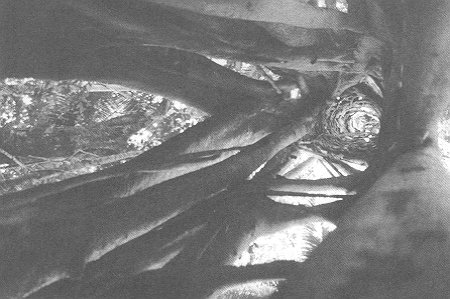
PHOTO NO 3 (REMOVE WHITE BORDER) REDUCE BY 5% Inside a
strangler fig, Cooper's Creek Photo: Dailan Pugh